The universe has jokes
Good Guys made She Does The City’s Most Anticipated Books of Early 2026 list! In it, they call my novel “an unputdownable thriller about the dark side of philanthropy.” Fun story about She Does The City…..
Good Guys made She Does The City’s Most Anticipated Books of Early 2026 list! In it, they call my novel “an unputdownable thriller about the dark side of philanthropy.” Fun story about She Does The City: my first brush with them was as a publicist, all the way back in 2007, when they were a brand new blog and I was a brand new person.
At the time, I was working in public relations for a prostate cancer charity and pitched She Does The City (successfully) on covering a wacky fundraising campaign where young men grew moustaches for the month of November.
Nineteen years ago, blogs were the bleeding edge of new media and I had to explain the concept to at least one older colleague. Working with the prostate cancer demographic, we were more used to getting media hits in places like Zoomer Magazine.
Well, what do you know, Good Guys ALSO made Zoomer’s 11 Reads for January round-up. They call it “a bracing and darkly comic novel” and “a thought-provoking look at the so-called altruism of capitalism.”
In conclusion, thank you to my publicist Natasha. And friends, life is not a box of chocolates. It’s a nesting doll of self-referential in-jokes.
Mirror
“I couldn’t put this novel down. I ended up bingeing it in two days. You know that kind of book? It’s full of office politics that have terrible consequences. Many of the characters are flawed in the most delicious ways. It’s a satire, a send up, about a charity falling from grace—”
“I couldn’t put this novel down. I ended up bingeing it in two days. You know that kind of book? It’s full of office politics that have terrible consequences. Many of the characters are flawed in the most delicious ways. It’s a satire, a send up, about a charity falling from grace—”
That’s the award-winning/ bestselling author Claire Cameron summing up Good Guys on her Substack.
It’s thrilling to get a rave like this, where you can hear the reader’s excitement, even more so because Claire is such a wonderful writer. (I binged her memoir How To Survive A Bear Attack over a couple of days in December.)
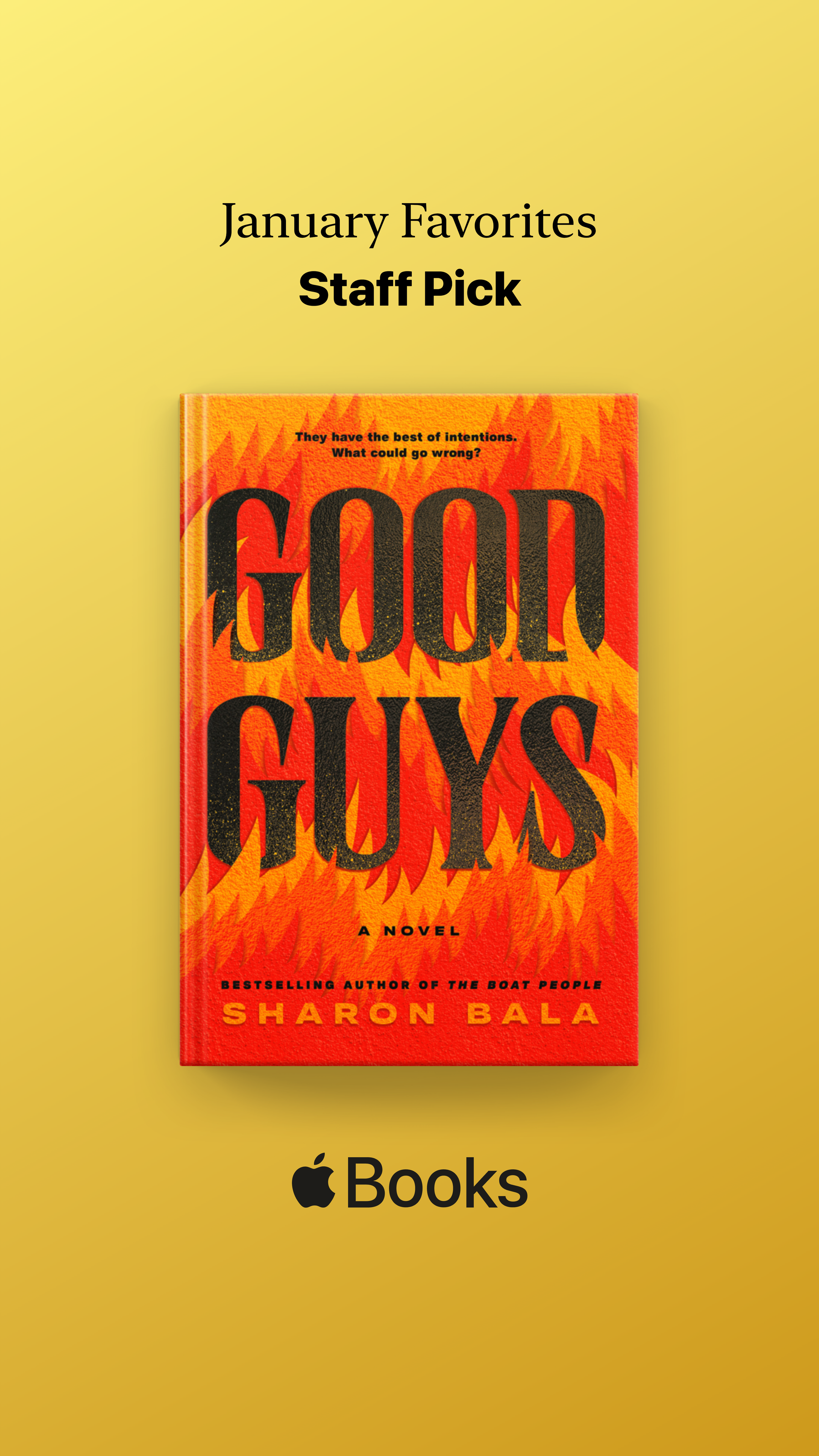
The morning after I read Claire’s Substack, I heard that the staff at Apple US chose Good Guys as one of their January favourites (!!!!!) and gave the novel a glowing review, saying: “This morally charged drama takes a clear-eyed look at power, money, and the uneasy line between helping and harming… Good Guys reads like a thriller with real philosophical tension, showing how good intentions can curdle once money and personal ambition enter the picture.”
The best reviews are a mirror, reflecting a book back to its author. A satire about money and power? A thriller with philosophical tension? Office politics and personal ambition curdling everyone’s good intentions? Yes to all of it! That’s exactly the book I wanted to write.
Blurbs
Recently, on CBC’s Commotion podcast. there was a dishy chat about blurbs. It’s worth a listen if you’re an aspiring author or have a first book deal or are curious about what it means to get a more established author or Barack Obama to say one nice word* that can be printed on your cover.
Most of us need blurbs and we all have a fraught relationship with them. It’s amazing to receive any sort of advance praise, especially when you’re deep in your feelings in that final stretch right before a new book comes out. But blurbs require hours of free labour. And the galling part is it’s impossible to do the (unpaid) job without toppling into cliche hell. To wit…
Recently, on CBC’s Commotion podcast. there was a dishy chat about blurbs. It’s worth a listen if you’re an aspiring author or have a first book deal or are curious about what it means to get a more established author or Barack Obama to say one nice word* that can be printed on your cover.
Most of us need blurbs but the relationship is fraught. It’s amazing to receive any sort of advance praise, especially when you’re deep in your feelings in that final stretch right before a new book comes out. But blurbs require hours of free labour. And the galling part is it’s impossible to do the (unpaid) job without toppling into cliche hell. To wit…
“A confident and lyrical debut penned by an author of uncommon talent.” (for Heather Nolan’s This is Agatha Falling)
“A vivacious debut from an author to watch” (for Jamaluddin Aram’s Nothing Good Happens in Wazirabad on a Wednesday)
“Clever and insightful, this book is a sheer delight.” (for Kerry Clare’s Waiting for a Star to Fall)
“A masterful collection, written with so much veracity, you’ll swear every word is true.” (for Souvankham Thammavongsa’s How to Pronounce Knife)
I once wrote “laugh-out-loud funny” in a blurb and was asked to please find a synonym because all the book’s endorsements included the same banality. In our collective defense: Shashi Bhat’s The Most Precious Substance On Earth is very funny and did make me guffaw.
Okay, so here’s a secret: I’m 95% more likely to consider a blurb request if it comes from a third party - agent, editor, publisher, publicist etc - instead of the author. I say no a lot more often than I say yes and the whole proposition is less fraught if it goes through a middleman.
But here’s the other thing: there’s more than one way to champion a book. I talk about books, write about books, recommend books to friends and family and clients and students. Whenever I lead a workshop, I pull passages from at least three or four authors. Just because I say no to a blurb, doesn’t mean I won’t find another way to be a cheerleader for the book.
*My favourite blurb always and forever is the one Obama gave Colson Whitehead’s Underground Railroad: “terrific!”
Cathedral
And then there's Eleanor Catton's The Luminaries, a book with more than its fair share of plot, "a gothic cathedral of plot!" At 800+ pages, maybe plot, erected on such an intricately designed scale with flying buttresses and gargoyles and stained glass, is necessity more than extravagance.
Originally posted: February 15, 2016
And then there's Eleanor Catton's The Luminaries, a book with more than its fair share of plot, "a gothic cathedral of plot!" At 800+ pages, maybe plot, erected on such an intricately designed scale with flying buttresses and gargoyles and stained glass, is necessity more than extravagance.
The Luminaries sat on my shelf for some time, sitting there like a door stop screaming "commitment." Then one January day, I was looking for a new read, something dense and hearty that might also help me break my online habit, and there was The Luminaries waving its hands, calling out: "pick me."
January seems tailor-made for mammoth reads. This is when - if you live in the northern hemisphere, at least - you want to crack open Middlemarch or The Byatt’s The Children's Book or the complete Sherlock Holmes. Cuddle up by the fire, tuck in to something substantial, and try to tune out the internet's siren song.
The Luminaries is set in gold-rush 19th-century New Zealand. A dead man is found in a cabin. A prostitute lies collapsed on the road. The richest man in town has gone missing. And on a night of torrential rain, a council of twelve convene a secret meeting. What is the thread that binds these things together? Eight hundred and thirty two pages later, you find out.
Catton adopts the 19th century Gothic as her style. Her narrator is all-knowing and arch, moving freely in and out of different characters' points of view. Everything is explained and very little is submerged. There are cliff hangers galore. In the role of the villain: an enigmatic man with a scar. It's the kind of page-turner that might have been written by a 21st century Wilkie Collins. All the suspense and classic story-telling of an earlier age with modern-day good sense (which is to say you find any simpering Angels in the House).
But perhaps this all sounds hopelessly outmoded. Haven't we moved beyond conventional plot and story-telling, evolved past the need for narratorial hand-holding? This reader has not! I found The Luminaries completely refreshing.
And make no mistake, Catton's characters are well-drawn and complex with flawed motives and inconsistent, deeply human, actions. Her scene-setting is on point. Themes of land appropriation and colonial entitlement, racism and inequality are handled with intelligence and empathy. Agency is found in unexpected places. (At one point a villain casts aspersions on the local prostitute, only to be reminded that as many men bare him a grudge, there are twice as many who love and would protect her.)
The Luminaries - which won a slew of prizes including the Man-Booker and the Governor General's - is immersive and sustaining. After a while I forgot the internet existed.
Lost the plot
Tessa Hadley has perfected a magic trick. And I want to know her secret.
She writes these novels - the most recent one is the excellent The Past - that break the rules of plot. Specifically the main rule that plot should progress in an Aristotelian arc.
Originally posted: February 10, 2016
Tessa Hadley has perfected a magic trick. And I want to know her secret.
She writes these novels - the most recent one is the excellent The Past - that break the rules of plot. Specifically the main rule that plot should progress in an Aristotelian arc. Characters are introduced. The scene is set. There is pressing conflict and tensions mount toward a peak. The handgun is shot, secrets are revealed, the story blows wide open. Then, climax discharged with, characters settle into a new normal and denouement eases into conclusion.
That is the formula. It's what readers expect, what keeps pages turning. But then along comes Tessa Hadley. And she's got no truck with any of that.
In The Past four middle aged siblings gather in the country home of their grandparents. Hadley tells the story through the eyes of the grown children and then, rewinding a few decades, from the point of view of their mother. Secrets are revealed, sure. There is a mystery, yes (the decaying carcass of a dog is found in an abandoned cottage) but it doesn't feel very pressing. There is a romance, yes. But it isn't very urgent. Doesn't this sound like the world's most boring book?
And yet, The Past is a compulsive read. I finished it in just a few days and then was sorry it wasn't longer (this, incidentally, is how I devour all her books and stories). What is it about Hadley? Her prose is faultless. She has a way of finding words for the things that are indescribable; her writing thrums with arresting moments of insight. And in her stories, character is queen. Her imaginary people - so flawed, so foolish, so endearing - continue to resonate long after the last page is read.
Is this the secret? Can conventional plot be replaced by insightful, well-crafted prose and pitch perfect characters? Are those three ingredients sufficient to propel a story forward? Somehow, I don't think it's as simple as following a formula. My suspicion is it's the exceptional writer who can pull this off, conjure story without plot. And those rare birds aren't giving away any of their secrets.