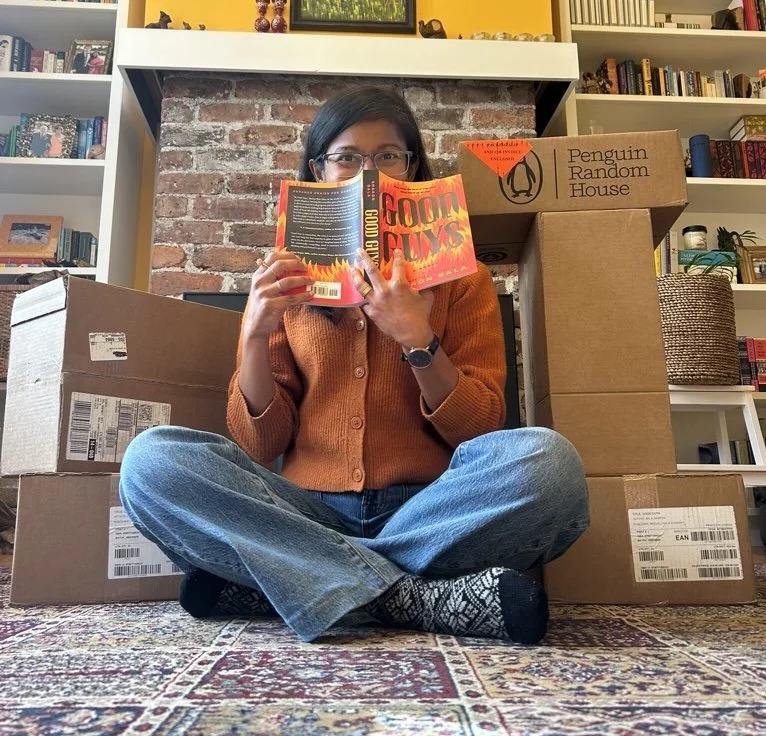
Today’s the day!
Good Guys is on sale today in paperback, e-book, and audio book!
I’m so excited to have my second novel out in the world. It’s been such fun hearing from early readers on instagram and reading the excellent reviews. Over the last few days, friends who received special copies from me have confessed they’ve been sneaking stolen moments with the novel during their work days and staying up late into the night because they couldn’t put the book down. Great! The manuscript kept me up plenty of nights. Your turn now, readers.
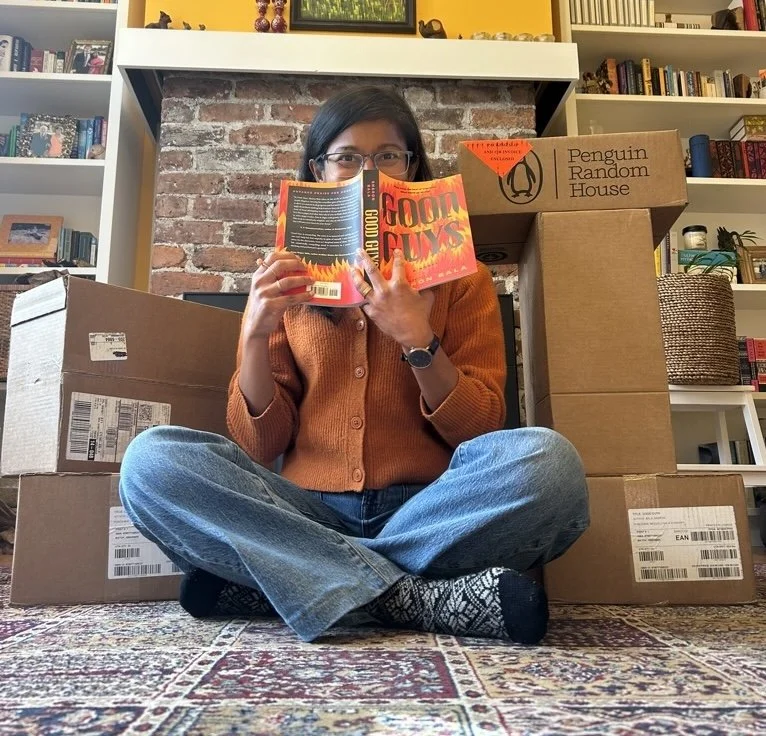
Good Guys is on sale today in paperback, e-book, and audio book!
I’m so excited to have my second novel out in the world. It’s been such fun hearing from early readers on instagram and reading the excellent reviews. Over the last few days, friends who received special copies from me have confessed they’ve been sneaking stolen moments with the novel during their work days and staying up late into the night because they couldn’t put the book down. Great! The manuscript kept me up plenty of nights. Your turn now, readers.
Last week, Good Guys was featured in Quill & Quire’s Spring Fiction Preview, alongside several other exciting new releases, including two I’m especially excited about: Kim Fu’s The Valley of Vengeful Ghosts and Anakana Scofield’s Library of Brothel. The Winnipeg Free Press also included Good Guys among it’s “bumper crop” of new books, alongside Lindsay Wong’s Villain Hitting for Vicious Little Nobodies and George Saunders’ Vigil (not to be confused with the OG Vigil, a superb story collection by Susie Taylor). No writer is an island and no book is ever written in a bubble. We and our books exist in community, influenced, inspired, and always in communion and conversation with each other.
So if you’re in St. John’s on Friday, I’ll be gathering with the community that sustained me as I wrote this book. Please join us.
The universe has jokes
Good Guys made She Does The City’s Most Anticipated Books of Early 2026 list! In it, they call my novel “an unputdownable thriller about the dark side of philanthropy.” Fun story about She Does The City…..
Good Guys made She Does The City’s Most Anticipated Books of Early 2026 list! In it, they call my novel “an unputdownable thriller about the dark side of philanthropy.” Fun story about She Does The City: my first brush with them was as a publicist, all the way back in 2007, when they were a brand new blog and I was a brand new person.
At the time, I was working in public relations for a prostate cancer charity and pitched She Does The City (successfully) on covering a wacky fundraising campaign where young men grew moustaches for the month of November.
Nineteen years ago, blogs were the bleeding edge of new media and I had to explain the concept to at least one older colleague. Working with the prostate cancer demographic, we were more used to getting media hits in places like Zoomer Magazine.
Well, what do you know, Good Guys ALSO made Zoomer’s 11 Reads for January round-up. They call it “a bracing and darkly comic novel” and “a thought-provoking look at the so-called altruism of capitalism.”
In conclusion, thank you to my publicist Natasha. And friends, life is not a box of chocolates. It’s a nesting doll of self-referential in-jokes.
Good Guys
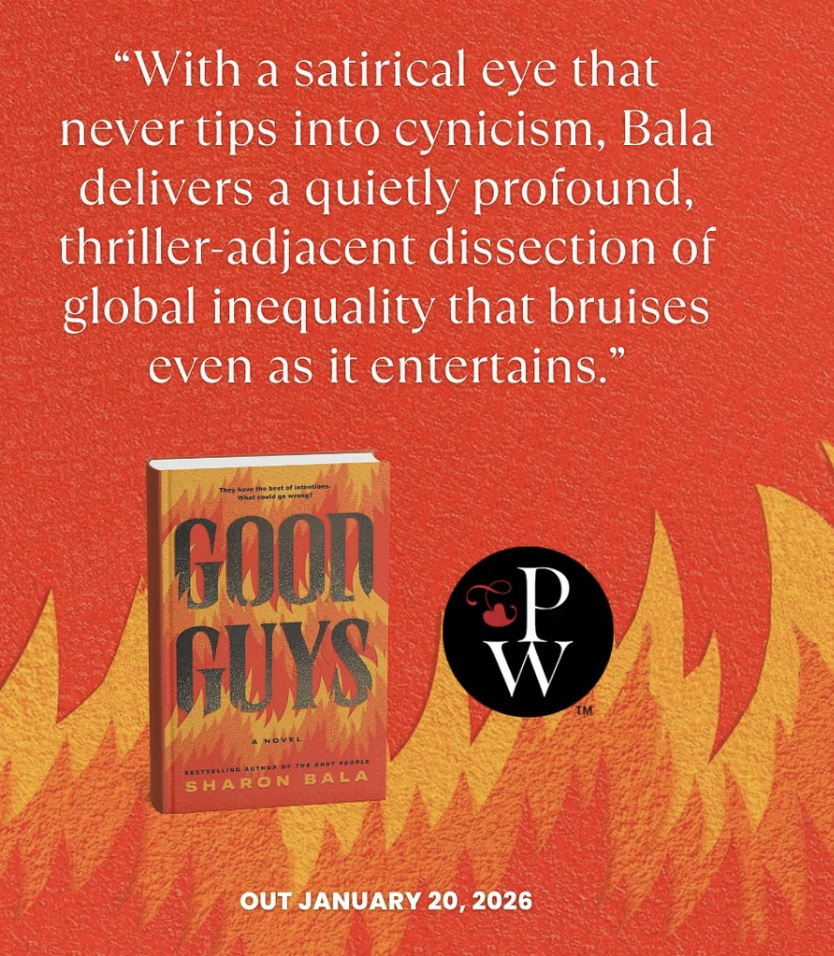
My second novel, Good Guys, publishes next month! Already advance review copies are making their way in the world, some bundled with a copy of The Boat People.* Publishers Weekly gave the novel a glowing review. Indigo named Good Guys one of their “Most Anticipated Books,” meaning you can pre-order from them for only $20. I’ve been invited to a couple of festivals and earlier today, I recorded a podcast interview. Slowly, surely, things are ramping up.
My second novel, Good Guys, publishes next month! Already advance review copies are making their way in the world, some bundled with a copy of The Boat People.* Publishers Weekly gave the novel a glowing review. Indigo named Good Guys one of their “Most Anticipated Books,” meaning that until Monday, December 15, you can pre-order from them for only $20. The launch party is scheduled for Friday, January 23 (7:30pm at Bannerman Brewing on the second floor. All are welcome!). I’ve been invited to a couple of festivals and earlier today, I recorded a podcast interview. Slowly, surely, things are ramping up.
Since the pandemic put an end to The Boat People’s promotional schedule, I’ve been a writer. Which is to say a person who writes, indoors, quietly, alone with her imaginary friends, her pens and post-its, and colour-coded plot outlines, occasionally in conversation with other writers, the select few who are invited into the private sanctum of a work-in-progress.
It seems to me that being a writer is very different from being an author. An author is a person in the world — on stage, at a signing table, a guest at your book club, behind a microphone, being interviewed. An author is an actor, performing the role of artist and consummate host. Welcome to my book. I wrote it just for you.
An author is a cog in the machine of capitalism. That’s a statement of fact, not cynicism. I’m thrilled to be a cog in this particular wheel. What a privilege to be an author! But all of this, selling a product, being a product, is miles away from writing and after five years, my authorial skills are rusty. During this morning’s interview, I could hear myself stumble and struggle to articulate myself. Iris Murdoch’s name escaped me. (Sigh). It’s sort of like riding a bicycle for the first time in years. I used to be really good at this but at the moment I’m wobbly. Eventually this ride will feel like second nature though, right?
* Good Guys and The Boat People are very, very different books but they have shared DNA, and in hindsight I realized there was unfinished business in The Boat People that I completed in Good Guys. I’m curious to know if readers catch the link.
Write who you don’t know
The Canadian Press interviewed me about every blowhard’s favourite topic: authors writing outside their perspectives. How do we create characters whose identities (skin colour, class, sexuality, gender, disability) are different from our own? Is it possible to ace the job and should we even try?
Originally posted: December 4, 2020
The Canadian Press interviewed me about every blowhard’s favourite topic: authors writing outside their perspectives. How do we create characters whose identities (skin colour, class, sexuality, gender, disability) are different from our own? Is it possible to ace the job and should we even try?
When the request came in, I almost turned it down. Despite what certain dinosaurs might like to believe, this isn’t a straight forward subject. It’s complicated and nuanced and too often dismissed as censorship. (As if there’s a giant mute button Brown people can press to silence writers we despise. HA HA HA. WE WISH.) I wasn’t about to let some unknown reporter twist my words to serve the Old White Man Agenda.
But my publicist assured me the journalist was sensible so I gave her quite a bit of my time and I’m not sorry. You can read the piece here. I was glad to see the article included interviews with other authors including Kim Davids Mandar who edited In | Appropriate, an excellent collection of interviews all about this subject. If I was the head of an MFA program, I would make the book required reading.
This Fall I’ve run two online workshops on “Writing Who You Don’t Know.” The first was for a small group in Alberta and the second for about 70 writers from all over the place including the US and the UK. The turnout at the second workshop was shocking, especially given it was Saturday morning and a number of west coast heroes rose before dawn to Zoom in. But then again, maybe it’s not so surprising. This is difficult work, tricky to pull off. Traditional how-to manuals offer no guidance, too little attention is paid to the subject in classes, and the homogeneity of the industry ensures there’s no sober second thought. Then some poorly written, trope-infested book comes out, the Internet pounces, and all the fragile snowflakes whine about how they will never again win a Booker just because they are straight white men (oh, for a mute button).
All to say, I’m here to help. I’ve got a one-hour workshop and a two-hour workshop, both test-driven and well received. And listen, if you’ve been following me here for any length of time, you know I’m not a charlatan. I’m a thorough and meticulous researcher. I put together thoughtful workshops that give attendees food for thought as well as practical craft advice. If you belong to an organization that would like to host an online workshop, get in touch for more details, references, and the price.